


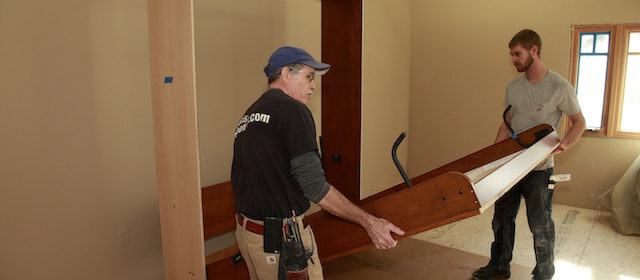




Hanging doors gets a little easier
Some days I hate my job.
Have you ever walked on a job and faced a pile of 150 solid core 3/0 x 8/0 doors? And they’re on the first floor? And there’s four floors? And no elevator? I have. All the time.
Erica Fischer reports on construction challenges facing post-earthquake Haiti.
Read more...
When the class was over, I didn't want to leave and go home.
Read more...
A miter saw stand is more than just a place to set your saw--it's a work station.
Read more...
Although I have owned pickups, my choice for work vehicles has always been a van.
Read more...
In Part 2, we'll finish constructing the stand and share some tips for souping up your saw.
Read more...
Operating a miter saw doesn't have to be tedious and frustrating.
Read more...
I've hung cabinets a lot of different ways. It was only recently that I found a system I liked.
Read more...
Earthquake Defense mechanical connections require a lot of planning.
Read more...
01
Building Inspections in Haiti
02
What I Learned At Festool Cabinet Training Class
03
Make a Miter Saw Work Station: Part 1
04
The Benefits of a Work Van
05
Make a Miter Saw Work Station: Part 2
06
Wooden Miter Saw Stand
07
How to Build a Storage Box
08
Super Wicked Awesome Cabinet Jacks
09
Why Hand Tools (Still) Matter
10
Carpenters of Steel
11
Miter Saw Tune-Up
12
SawGear -- A First Look
Letter from the Publisher
Moisture Content
Ramps for the Handicapped
Moisture Meters
Pin type Moisture Meters
Book Review: Shop Class as Soulcraft
Sketchup for Finish Carpenters
When Special Orders Go Bad
Carving a Volute
Making Money on Built-ins
Photographing Your Work
Top Dog
Drawing A Volute
Dewalt Table Saw
Raising Gable Walls
Carving a Volute
Carving a Canoe Paddle
Wood Turner
Top Dog
The Misused & Confused Chair Rail
Bosch Angle Finder
Miter Saw Tune up
Building a Chippendale
DeWalt Saw
Multi-Tasking Tools
Top Dog
Terminating Versus Supporting Moldings
New & Cool
Story Poles for Stairs
Carving a Volute
Not so Big
Tools in Use
Tool Box
Hanging doors gets a little easier
Some days I hate my job.
Have you ever walked on a job and faced a pile of 150 solid core 3/0 x 8/0 doors? And they’re on the first floor? And there’s four floors? And no elevator? I have. All the time.
The new Lead Renovation, Repair, and Painting Rule (RRP Rule) will take effect April 22, 2010. Like many new government policies, there appears to be a lot of confusion about what this rule means, both in practice and in cost. Read the full article…
I’ve been working with my dad for 15 years. In those years, I’ve learned almost everything I know from him. But lately I’ve been picking up some great techniques from the JLC Forums, and they’ve changed the way we work. Yes, they’ve even changed my Dad’s approach to a craft he’s been practicing for over thirty years.
On a recent job, we were asked to install all of the window stool at the same elevation throughout the home, and tie together the stool on adjacent windows. I’ve done this same work before many times, using wooden shims. But that technique has always been frustrating. Read the full article…
Our new format: Up in arms?
As a professional carpenter as well as an admitted bibliophile (collecting both books and magazines pertaining to trade craft), I just wanted to express my disappointment that you have decided to switch to a different layout than that offered with iPaper. The release of your e-magazines each period was more exciting to me to receive than most table magazines I receive.
Just when I thought you would be the forerunner in the woodworking genre e-book transition, you go the direction that so many other craftsmen-oriented websites go: the blog and forum. Read the full article…
or: One Window at a Time
Every once in a while we have an opportunity to do something that makes a difference — something that has meaning beyond the everyday duties and responsibilities of being a parent, or partner or community member. Not to dismiss being a good parent or spouse but sometimes the opportunity to go beyond comes our way.
Read the full article…
Carpenters looking for new jobsite table saws have probably noticed that riving knives are now standard equipment on ALL table saws (see TiC issue three), a critical safety improvement that not only saves fingers but also improves table saw performance.
But if lawyers have their way, we may soon be seeing SawStop technology on every table saw. And that will mean a significant improvement in table saw safety AND a significant boost in table saw prices, too. Read the full article…
“How I built a reputation that is now worth money to me as a builder”
We all owe a debt of gratitude to Jeff K. Burks for the tremendous effort he makes to discover, copy, and share these jewels! Years ago, Jeff introduced me and countless other carpenters to C Howard Walker’s seminal book, The Theory of Moldings. Here, Jeff provides us with a telescopic view of the past: timeless lessons that carpenters should heed today about building better business practices. Read the full article…

Where Wright was Right and Wright was Wrong
I recently read The Fountainhead by Ayn Rand. What a great story about an architect—Howard Roark—who refuses to compromise his creative ideals or his personal values. In a biography of Frank Lloyd Wright, Brendan Gill discusses the comparison between Wright and Roark, and the common misconception that Rand based her character on the famous architect (Many Masks, pg. 490-492). After reading several biographies of Wright (and learning Wright was a colossal egotist), then visiting many of his homes (where I was overwhelmed by their timeless beauty), I have to agree: it’s too bad there wasn’t more in common between the man and the myth. But Wright’s work, and especially his influence on architecture, will definitely outlive his personality. Read the full article…
When I started teaching carpentry clinics at lumberyards around the country, one of the first companies I sought support from was Stabila—I used their levels for a couple of decades and wouldn’t think of switching brands. There was no other spirit level available that guaranteed the same degree of precision, whether the vials were right-side up or up-side down.
When I first started in the trades, I used an adjustable level, but threw it away after setting door jambs in a home getting bull-nose drywall. Read the full article…
Help keep TiC running FREE!
Please visit our sponsors:

