While this article won’t teach you everything about crown molding, it will get you started on the right foot!
Read the full article…
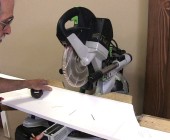





While this article won’t teach you everything about crown molding, it will get you started on the right foot!
Read the full article…
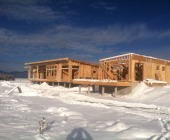
Over the years, I’ve done my share of beam work, but I didn’t get a taste of real timber framing until a few years ago, during the recession, when a friend and I salvaged an old barn—there wasn’t much work around and the opportunity presented itself. Even though the barn had outlived its useful days and the roof had failed, most of the timber framing was still stable. And here’s why—joinery. Read the full article…
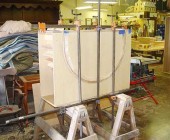
This is a pretty simple process for making radius jamb heads. To ensure perfect accuracy, we made plywood form plates using a router and trammel arm. Read the full article…
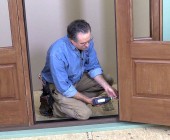
For the 2014 IBS show, Plastpro asked me to produce a special presentation on installing an SDS unit. They shipped me all the materials so I could practice the presentation and shoot a video before the event. I was kind of surprised when the freight delivery arrived and the package was so small—the entire unit came knocked down, which reminded me of the olden days. Read the full article…
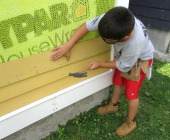
Co-written by Emanuel Silva
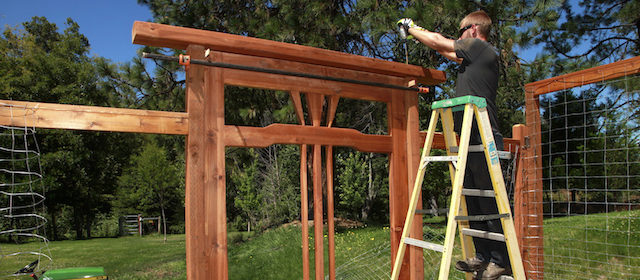
In my last article, I wrote about installing a fence post. Although it was dirty and hard work, I enjoyed every minute of it. Seeing that fence post today, standing plumb and solid, makes me feel glad that all the steps I did were well worth it. Read the full article…
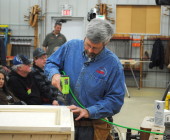
So much was happening back in the first weeks of September 2001. Reading the news and watching videos of the Twin Towers, few of us knew that Roger Cliffe passed way, after suffering a heart attack while riding his bike. While some people knew him as Dr. Cliffe, because he taught technology classes at Northern Illinois University, many of us knew Roger as a prolific author of woodworking books (Table Saw Techniques, Radial Arm Saw Basics, The Shaper Handbook, etc. ), and as an extremely approachable woodworking instructor. Read the full article…
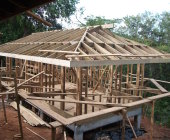
In 2011, I was given the opportunity to frame up four small houses with Dutch Hip roofs on a remote island in the tropics. I planned to use the experience to teach the contractor’s crew western style framing. Read the full article…
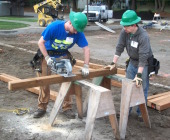
We live in a society that undervalues blue-collar work. In the late 80s and early 90s, when computer technology grew by leaps and bounds, industrial arts classrooms were turned into computer labs; students were taught that a four-year degree was the only accepted path after high school. Today, we see a huge increase in the number of college graduates that cannot find a job in their field because a flood of new graduates—in addition to the existing workforce—are competing for the same job. Read the full article…

Our stop in Clinton wasn’t just about the changes in the millwork industry due to advances in technology. It was really a study of the consequences (often unseen) that resulted from leaps in technology. The technological leap that took place in Clinton, Iowa in 1870 was ultimately the result of the Industrial Revolution. Other leaps for homes occurred as power tools came on the job, and these leaps continue today as computer controlled machines (CNC) take over our shops and mills. It is a strange and ironic fact that an increased level of technology and the increase use of technology in building does not necessarily lead to higher quality or more beautiful homes. Read the full article…
Our story begins in Chicago. Though the hammer was not invented here, it is where the current use of the hammer was born. Up until the early 1800s, if you were going to build a house or a building, you did so with large timbers that were cut and fitted together like a large, well-made chair. Using mortise and tenon joints, along with pegs, large timbers—6 or 8 in. across—were cut and fit together yielding a house of mass and strength. All houses and buildings of wood, pre-1830/40, were built with timbers; they were all timber-framed. Read the full article…
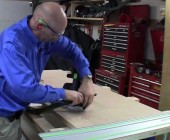
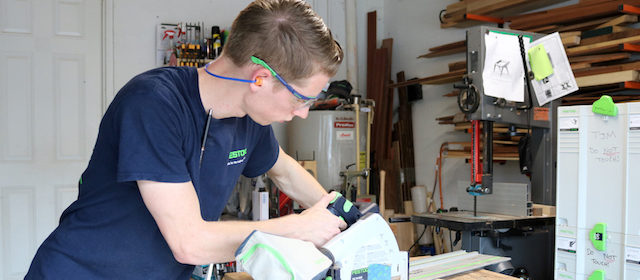
I recently worked on a video series for Festool in which I covered examples of how you might use a Festool track saw in a shop or on the jobsite. In the following videos, I demonstrate how a track saw produces exceptional results when trimming down doors, how using a track saw can save time and additional steps when back beveling a door, and how a track saw offers a better solution than a table saw for making complex bevel or miter cuts. Read the full article…

For the last six or seven years, I’ve included some type of architectural trim presentation during my Finish Carpentry Clinics at Katz Roadshow events. For most of that time, I’ve built a fancy pediment with raking molding joined by a transition piece—a Greek Revival design common throughout the country. You can read more about that pediment in “Greek Revival and Italianate Trim.” Read the full article…
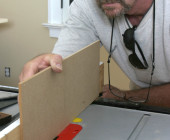
In my shop, I use dado blades a lot. So much so that I keep one table saw as a dedicated unit with dado blades in it all the time. I find that, for one cutter, the number of operations I can complete is worth the money and floor space required. Read the full article…
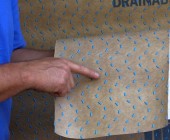
Some people (mostly folks who live in big cities!) think that builders who live in small towns are behind the curve when it comes to technology and better building practices. But the truth is that every state in the U.S. is actively improving building codes, and through new requirements on everything from decks to framing to air infiltration to housewrap, even small towns in America are getting up to speed. Read the full article…