
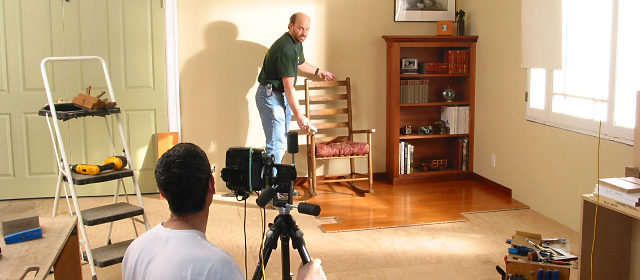

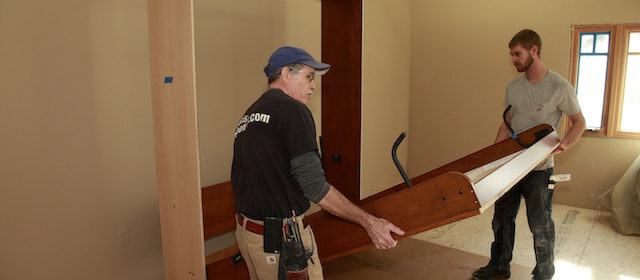
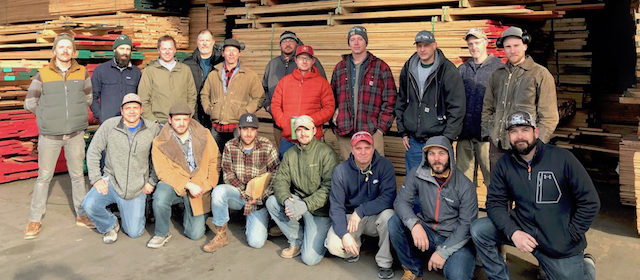
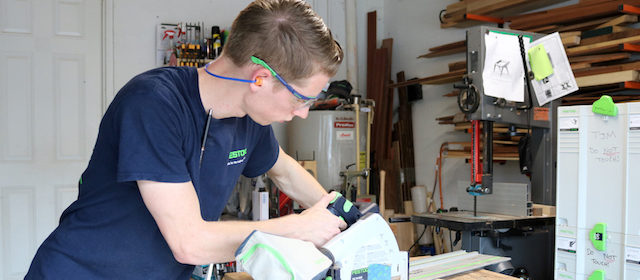



I recently had the honor of being invited to participate in Festool’s cabinet-making class at their corporate headquarters in Lebanon, Indiana. The class was two full days of solid training…and it was a lot of fun. They have a complete training room set up there, stocked full of tools—more than a person could dream of having in their own shop. In fact, when the class was over, I didn’t want to leave and go home. They had to make me. Read the full article…
No matter how much or how little you invest in a miter saw, the quality and enjoyment of your work will depend more on your saw stand than on the miter saw itself.
A miter saw stand is more than just a place to set your saw—it’s a work station.
Manufactured stands are available that are easy to set up, transport, and store, but if you’re working at your home, in a couple hours, with $50 or $60 in material, you can make your own. In this chapter, I’ll show you how. Read the full article…
Some of you may have noticed the loss of Acme Tools’ online website several years ago? Well…THEY’RE BACK! Read the full article…
Once you figure out the math, the rest is just glue and sawdust.
[This article first appeared in the page-flipping version of TiC, Issue 2]
“You want what?” You’re kidding!”
That’s what I thought when some very good clients asked me to build a railing for a second floor deck above a living space. I hesitated — I normally do interior finish work, not decks.
But when they said they were thinking of a Chinese Chippendale balustrade, they got my attention. In general terms I knew what Chinese Chippendale design was — I’d just never built anything with the geometric fretwork patterns that mark that style. It’s beautiful stuff.
Read the full article…
Erica Fischer reports on construction challenges facing post-earthquake Haiti
The earthquake that hit Haiti on January 12th was described as a “middle-class disaster.” I was not sure what that meant until I arrived in Port-au-Prince on March 20th and began doing building assessments with the ATC-20 guidelines. Those who could afford proper building materials, a structural engineer to design their house, and a skilled mason to build the house, had homes which were in pristine condition. These people are considered the upper class.
Those who could not afford proper building materials, and either built the house themselves, or had a mason who did not know proper construction methods, were left with collapses and damages beyond repair. This group was the middle class. Read the full article…
[Editors' note: Our thanks to Bill Bode for inviting us into his shop for this story.]
Not long ago, we visited Bill Bode in his garage shop on Long Island.
Mike Sloggatt had said about Bill: “Wait till you see this guy’s shop! He’s the exact opposite of me. You can eat off the floor of his garage.”
Read the full article…
[Editors' note: Our thanks to Bill Bode for this tip!]
How many times have you pushed a sheet of MDF or a wide board through your table saw and wondered if it was really tight against the rip fence? They often look tight, but if the light hits a board just right, there’s a slight shadow right between the board and the fence. Sometimes that shadow drives us nuts. Is the wood tight against the fence or is there a small gap?
Read the full article…
Have you ever said to yourself, “How’d they do that??” I have. Lots of times. And when I found a mysterious casing on a recent job, I said it again. This time, though, it took a little longer than a day or two to figure out how they did it.
I was in the midst of trimming out a recent remodel when one of the guys described a miter joint he’d noticed while doing the demo work. What he described sounded more like a Japanese temple building joint than the conventional miter joint found in your typical American house. I was intrigued. When he found a sample of the joint and showed it to me, I was amazed.
Read the full article…
Start with the Finish and Work Back to the Rough
A lot of carpenters scratch their heads every time they finish framing a porch and start on the stairs. There are so many ways to frame stairs on a porch that it’s hard to make a logical choice, let alone use the same technique twice. That’s why, to work on this story, we gathered together a group of carpenters, all JLC authors: Mike Sloggatt, Frank Caputo, Jed Dixon, Carl Hagstrom, Tom Brewer, and Greg DiBernardo all contributed to this article. Together we worked out a simple system for installing stringers, so you won’t have to scratch your head the next time you start on the stairs.
Read the full article…