If you ever have that problem where the base is thicker than the casing, and—like me—you hate to see back-cut joints, try this little trick. Read the full article…



If you ever have that problem where the base is thicker than the casing, and—like me—you hate to see back-cut joints, try this little trick. Read the full article…

If you’re lucky to stay in the carpentry business long enough, you’ll see a lot of strange things, like the crown molding in this article. Read the full article…

It’s pretty moist at my new home in Southern Oregon, but no matter where you live, you need to be sure to check the moisture content of your material before you install it, especially if you get a second shipment! Read the full article…

Co-written by Mike Sloggatt
Around 2,500 years ago, a Greek philosopher we all met in high school named Pythagoras discovered a theorem that can make life easy for carpenters and contractors—if we just knew how to use it, and how to find right angles!
Most of us remember our ABC’s from high school, and we remember the Pythagorean Theorem, too, which applies to any 90-degree triangle. Read the full article…

The standard scarf joint. Every carpenter is expected to make this field splice to join two lengths of molding. How often does the joint match perfectly? Any number of variables can affect the quality of the splice: Imperfections in the millwork, waves in the wall framing, taping compound buildup, inaccurate miter saw setup… Read the full article…

I’ve been hanging doors for over thirty-five years, and writing about it for nearly twenty-five. For many years, I approached door installs differently every time (like most carpenters). After all, there are so many steps, and there is a lot you need to watch for! It’s tough to do it the same way every time. But a door is a door is a door. Which means unless you’re doing exactly the same thing every time you install one, you’re wasting valuable energy and time. Read the full article…

When I first read Norm’s article on skirt scribing, four thoughts immediately came to mind:
1) He and I both learned the technique from the same instructor, Don Zepp.
2) Norm’s explanation of the process was spot on.
3) I had a bunch of photos of a skirt board I had installed that I should share with others.
4) I felt exactly like Norm did: Don Zepp was absolutely the best instructor I’ve ever had the good fortune of learning from. Read the full article…

I recently worked on a video series for Festool in which I covered examples of how you might use a Festool track saw in a shop or on the jobsite. I typically work out of a small garage-based shop, and yet I’m able to process sheet goods in a one-person operation with limited space—something that wouldn’t be nearly as easy with a table saw. Read the full article…

Sharpening tools properly must be one of the hardest lessons to learn in carpentry. And yet the path to success is simple. Unless you’re a tool junkie, or my friend Gary Katz, it doesn’t require fancy or expensive equipment. Read the full article…

Four-centered arches are most often found in Victorian homes for a simple reason: Victorian architecture is a blend of neo-classical styles and Gothic designs. And there is no better example of Gothic revival architecture than a four-centered arch. Read the full article…

Miter saw gauges confuse a lot of finish carpenters for one simple reason—they aren’t designed for finish carpentry, they’re designed for framing and stairs. Let me show you what I mean. Read the full article…

Van racking is basically just trim carpentry with loads of scribes, using elements of North American face frame construction and European box systems of cabinet making. But it’s also an exercise in extreme organization. Getting it right can save you time and energy on the jobsite—both of which lead to increased productivity and profits. Read the full article…

A while back, Dan Broadbelt wrote an article about a computer stand he built for his work van. It was simple, but seemed like an ingenious idea. One problem, though: I use an iPad. Nonetheless, the idea was planted, so I decided to try my own version. Read the full article…
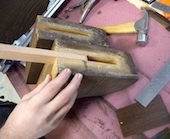
A recent article in THISisCarpentry—“Craftsman Style Mantel and Bookcases,” by Brian Cinski Jr.—referenced the book “Building Fireplace Mantels,” by Mario Rodriguez. Brian used this book to replicate a stunning Charles Rennie Mackintosh mantel and bookcase. I was intrigued, and ordered a copy of the book. Inside, I found many great tips, as well as a plethora of techniques I had never imagined. One in particular amazed me: the “sliding dovetail cleat.” Read the full article…