


Subscribe to TIC

TIC Merchandise

Craftsman Style Mantel & Bookcases

Tackling a demanding project requires a careful drawing & plenty of wiggle room.

Not long ago, a friend of mine referred one of his coworkers to me who was interested in replacing the fireplace-surround of an old bungalow he and his wife had just purchased. Excited by the opportunity, I set up an appointment to visit the site. What I found was a room in desperate need of a makeover. The phone conversation I had with the clients before the meeting gave me an idea of what they were looking for: something traditional, while keeping with the bungalow theme. Armed with a few books and magazine clippings, I met with the new owners. Read the full article…

Raked Baseboard Returns

Hand tools should be a part of every carpenter’s arsenal.

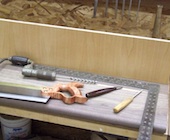
There was a time—not too long ago, really—when carpenters approached problems differently than they do today, and the solutions they conceived were different, too. Some readers might suspect I’m talking about raked crown on an open pediment, but that’s a rare problem encountered in only a few homes. Read the full article…

Understanding Moisture Content and Wood Movement

(with Gene Wengert, The Wood Doctor.)

Expected movement can be accurately predicted, which means avoiding potential problems down the road.

In this article, we’ll explain the importance of understanding wood movement, how to use a moisture meter to measure the moisture content (MC) of trim, how to decide when a load of trim should be rejected, and how to accurately estimate how much trim will move after it’s installed. Read the full article…

Shop Kitchen

About twenty years ago, I got some rough cherry boards from Grandpa’s garage attic. He had cut down a cherry tree in his yard back in the 1930s, sawed it into boards, and put it up in the attic to dry. It sat in my barn for more than 10 years before I could figure out what to do with it.

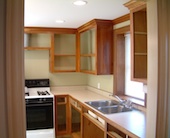
A few years ago, I decided that it was time to renovate the Collins Tool Company shop kitchen—make a nice place where we could fix lunches, and also demonstrate our tools. I didn’t have enough of the cherry to build boxes, and I didn’t want to buy a bunch of expensive plywood, so I decided to use it for the kitchen project. Read the full article…

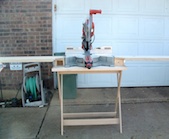
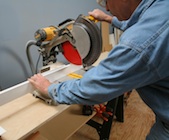
Miter Saw Tune-Up

If your miters aren’t as tight as they used to be, here’s how to get your saw singing on pitch again!

Every carpenter should know that when you buy a new chisel or hand plane it’s not razor sharp out of the box — you have to sharpen it before using it. Well, the same is true for miter saws. They don’t come from the factory in perfect tune.

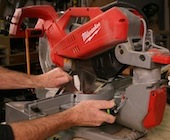
Besides, after you’ve dragged your saw in and out of the truck a few dozen times, or jammed heavy stock against the fence, or maybe even had it flip off the back of a saw stand — or a tailgate — all those precise adjustments can get seriously out of whack. If you’ve noticed joints not quite closing up for you lately, it’s probably time to tune up your saw. Here are a few tricks to get that big investment dialed in just right. Read the full article…

Carpenters of Steel

Earthquake Defense mechanical connections require a lot of planning.

With the 2007 CBC codes addressing Earthquake Defense more progressively, we’re feeling more like Carpenters of Steel than carpenters of wood! The amount of steel in new buildings in California for seismic structural engineering is changing the way carpenters frame. For production framing here in California, we used to use the words “blow and go” a lot. But those days are over. Now all anyone talks about is “mechanical connections.” Read the full article…

Wooden Miter Saw Stand

I am a cabinet maker. I own and operate a small shop. I do it all, from making the sale to installing the pulls. Crown molding is standard on all my cabinets, unless the client wants something different. So on 99% of my installs there is crown molding involved. I used to use a small 10-in. single bevel miter saw that worked just fine for most of the crown I needed to install. Occasionally, I would run into something that was too big for my saw to cut, but I was always able to find a way to “make do.” Sound familiar? Read the full article…

The Benefits of a Work Van

Finish carpenters carry a lot of tools. In fact, we carry more tools than any other trade I know, maybe more than any two combined. Sure, plumbers carry a lot of weight, but that’s mostly pipe. We carry tools: table saws, table saw stands, outfeed tables, miter saws, miter saw stands, work tables, nail guns (at least four), drills (at least four), routers (at least four), planers, grinders, sanders, circular saws, track saws, compressors, air hoses, extension cords—and that’s just the big stuff. Then there’s the nails, screws, glue, sand paper…the list goes on and on.

You’d think that after 15 years in this business I’d hate tools, but I love them. The problem is, how to get them to the job, and how to store them so I can find them! Read the full article…

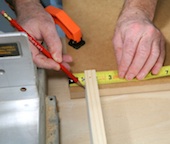
Make a Miter Saw Work Station: Part 1

No matter how much or how little you invest in a miter saw, the quality and enjoyment of your work will depend more on your saw stand than on the miter saw itself.

A miter saw stand is more than just a place to set your saw—it’s a work station.

Manufactured stands are available that are easy to set up, transport, and store, but if you’re working at your home, in a couple hours, with $50 or $60 in material, you can make your own. In this chapter, I’ll show you how. Read the full article…

Building a Chinese Chippendale Balustrade

Once you figure out the math, the rest is just glue and sawdust.

“You want what?” You’re kidding!”

That’s what I thought when some very good clients asked me to build a railing for a second floor deck above a living space. I hesitated — I normally do interior finish work, not decks.

But when they said they were thinking of a Chinese Chippendale balustrade, they got my attention. In general terms I knew what Chinese Chippendale design was — I’d just never built anything with the geometric fretwork patterns that mark that style. It’s beautiful stuff. Read the full article…

Solving Porch Problems

Start with the Finish and Work Back to the Rough

A lot of carpenters scratch their heads every time they finish framing a porch and start on the stairs. There are so many ways to frame stairs on a porch that it’s hard to make a logical choice, let alone use the same technique twice. That’s why, to work on this story, we gathered together a group of carpenters, all JLC authors: Mike Sloggatt, Frank Caputo, Jed Dixon, Carl Hagstrom, Tom Brewer, and Greg DiBernardo all contributed to this article. Together we worked out a simple system for installing stringers, so you won’t have to scratch your head the next time you start on the stairs. Read the full article…