


Subscribe to TIC

TIC Merchandise

Kickback: Letters from TiC Readers

Our new format: Up in arms?

As a professional carpenter as well as an admitted bibliophile (collecting both books and magazines pertaining to trade craft), I just wanted to express my disappointment that you have decided to switch to a different layout than that offered with iPaper. The release of your e-magazines each period was more exciting to me to receive than most table magazines I receive.

Just when I thought you would be the forerunner in the woodworking genre e-book transition, you go the direction that so many other craftsmen-oriented websites go: the blog and forum. Read the full article…

An Award-Winning Letter

“How I built a reputation that is now worth money to me as a builder”
A reprinted article from American Carpenter & Builder, July, 1912.

We all owe a debt of gratitude to Jeff K. Burks for the tremendous effort he makes to discover, copy, and share these jewels! Years ago, Jeff introduced me and countless other carpenters to C Howard Walker’s seminal book, The Theory of Moldings. Here, Jeff provides us with a telescopic view of the past: timeless lessons that carpenters should heed today about building better business practices. Read the full article…

Falling Water

Where Wright was Right and Wright was Wrong

I recently read The Fountainhead by Ayn Rand. What a great story about an architect—Howard Roark—who refuses to compromise his creative ideals or his personal values. In a biography of Frank Lloyd Wright, Brendan Gill discusses the comparison between Wright and Roark, and the common misconception that Rand based her character on the famous architect (Many Masks, pg. 490-492). After reading several biographies of Wright (and learning Wright was a colossal egotist), then visiting many of his homes (where I was overwhelmed by their timeless beauty), I have to agree: it’s too bad there wasn’t more in common between the man and the myth. But Wright’s work, and especially his influence on architecture, will definitely outlive his personality. Read the full article…

Customizing a Table Saw Stand

A unique approach to making a full-function work center

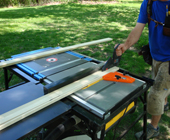
As a young carpenter living in an apartment and specializing in residential remodeling, I have to wear a lot of hats—and make them all fit into a truck and small trailer. That is why I always look for tools and techniques that combine multiple tasks into smaller packages, especially when it comes to table saws and table saw stands. To start with, I’ve always wanted one that would fit in my truck, but that’s just for starters. Read the full article…

Exterior Porch Details for Traditional Materials

Drive through a new subdivision today and you’re greeted by homes covered with large swathes of vinyl and plastic. Step onto a porch and meet more plastic—floors, railings, columns…the list goes on and on.

In many homes, plastic has replaced wood and permeated almost every exterior building product. Not surprisingly, builders have become fluent at installing plastic, while wood skills have begun to disappear. Just when we need them most. Read the full article…

Shop Class as Soulcraft

A book every craftsman should read

“What sort of personality does one need to have, as a twenty-first-century mechanic, to tolerate the layers of electronic bullshit that get piled on top of machines?”
–Matthew Crawford, Shop Class as Soulcraft: Penquin Press, 2009

I recently taught a class on Mastering the Miter Saw to a group of mixed-age students at the West Valley Occupational Center, near my home in Los Angeles. I’ve volunteered to teach classes there before. The instructors teach drafting, framing, electrical, drywall—a general hands-on course covering everything about construction with blackboard backup. It’s a great program for anyone new to the trades. But I was surprised to find the class stalled by a lack of building materials. One instructor was digging into his own pocket to keep his class going. Read the full article…

When Special Orders Go Bad

When the GC got to the jobsite on Monday morning, I could tell from the look on his face that something was wrong. After a quick glance at the materials in the back of his truck — two special order interior doors and some small moldings, I knew exactly what it was. The special order doors, like a lot of other special order items that are delivered near the end of the job, were the wrong ones. Read the full article…

An Introduction to SketchUp for Finish Carpenters

— It works the way a carpenter thinks.

If you are tired of working out trim details on a scrap of wood or making shop drawings with graph paper and a ruler, SketchUp is your answer. Unlike most computer-aided design programs you may have tried, SketchUp is very intuitive and works the way a carpenter thinks.

SketchUp has a simple set of tools that you can use to create anything from a rough mock-up to a very detailed drawing with 1/64″ precision. How much detail you want is up to you. The ability to convey your ideas to customers quickly and to produce working shop drawings is what SketchUp can do for you. Are you intrigued? What if I told you that it’s FREE! Read the full article…

Making Money on Built-ins

Selling yourself: Like it or not, marketing matters.

I started my Handyman business in Los Angeles, CA back in 1999 after leaving a 23-year sales career. I made a good living in sales, but it wasn’t satisfying. I’ve always been interested in fixing things, and even more interested in working with wood.

Over the years, I’ve learned a lot — there’s a huge difference between the work I do today and the funky 1×10 knotty-pine nailed-together bookcase I built for my bedroom as a kid. Today, the jobs I enjoy most, and the ones I make the most money on, involve fine finish work, including custom cabinets, bookcases, and built-ins of every type. Read the full article…

Using Impact Drivers

A few years ago, other than the noise of saws and nail guns, jobsites were pretty quiet. But today, on almost every construction site, you’re liable to hear the clacking of an impact driver. After all, most of us have become completely dependent on them for driving screws: they never strip out a head, even when you’re driving a screw in tough wood; even if you’re standing on a ladder reaching over your head, you can still drive a long screw without throwing your weight behind the driver; and you can drive handfuls of screws without tiring. Read the full article…

Terminating Versus Supporting Moldings

If I were to say: “Hi are how you? Brent I’m Hull.” You might wonder what I drank for breakfast. I mean, you’d recognize the words, they’d sound familiar, but the way I used them wouldn’t make any sense. But if I said: “Hi, how are you? I’m Brent Hull,” you’d respond without a hitch, my words would make perfect sense (depending on what you drank for breakfast!).

Well guess what? There is a language to classical design, too; a vocabulary that’s dependent on moldings for communicating purpose in a room. If you speak the language, all your finish work—your, bookcases, mantelpieces, doorways, and ceilings―will communicate fluently with your customers. Read the full article…

Not So Big

A not-so-big carpenter gears up: Shopping for equipment to fit size small in an industry that caters to XXL.

I’ve been a woman in the construction trades for over twenty years now. I’ve learned to frame, finish and fix along with the other guys. I can trade job-site humor with the best of them, and I can even deal with patronizing salesmen, with their soft pink hands and spotless work boots. But for me the hardest part of all has been finding professional clothing and equipment that fits a not-so-big carpenter. Read the full article…

Story Poles for Stairs

A simple tool takes the guess work — and a lot of the brain work — out of making safe comfortable stairs.

Every time I’m asked to bid or to build a set of stairs, I unroll the plans, look at the details, and shake my head. Architects rarely include and often they don’t even have the basic information I need, the few specifications that allow me to build a staircase that will meet the stringent requirements of building code in my area. Read the full article…