Subscribe to TIC

Posts tagged with “craftsmanship”

Book Review: Traditional American Rooms

A resource for classical details

I apologize. I read this book more than a year ago and wanted to write a review but never made the time, and I should have. Sure, we’re all busy and short of time, but the truth is, if something is important to you, you make the time, even if it means sacrificing something else that isn’t as important—at least for a little while. And that’s often what it takes to read a good book. This is one I recommend highly to anyone interested in classical architecture and the design of traditional American homes. Read the full article…

Grinding Custom Shaper Knives

Learning to make your own tools is a step up for the serious woodworking carpenter

Most of my work is at the high-end of the New England custom home market. For the jobs I do, in Boston brownstones that even today sell for several million dollars, there are no off-the-shelf parts—everything is completely custom, or an exact reproduction of work done in the 18th or 19th centuries. Read the full article…

Glass Elegance

The Art of Etching Glass with Sand

What’s a story on etched glass doing in a carpentry magazine? Good question. I don’t know the exact answer. All I know is that every aspect of construction interests me, and when I met Donna Burrows and visited her studio, I knew that other readers would be interested in seeing what I saw. Maybe it’s something about craftsmanship. Read the full article…

Working with Melamine

Melamine can be a viable option for many projects — with good conscience and no apology.

I remember reading an article about melamine years ago. The author was very apologetic about the topic because he knew he was addressing woodworkers who had a disdain for the material. Melamine has a rap sheet alright; it is looked down upon by both fabricators and consumers for its imitation wood grain and particleboard core. However, like it or not, it does have a place in the world of cabinetry. And that place is not always located at the bottom of the food chain. Read the full article…

A Coffered Ceiling & Media Room

Concept to completion: Having vision is half the battle

Like a lot of high-end jobs I work on, I’m sworn to secrecy about the clients. All I can say is, this job was on a pristine 7-acre waterfront property on Long Island’s Gold Coast, overlooking Connecticut and the Long Island Sound. The main house is about 7500 sq. ft. of new construction. It’s a to-die-for spot—the view was breathtaking. Even working on this job was incredible. The funny part is how I landed the work. Read the full article…

Miter Saw Fundamentals

Learn to swing your saw without visualizing the mitered corner

I used to close my eyes and visualize which way to swing my saw, especially if I was mitering a tricky corner. When I first started using a miter saw, there was a time I’d cut the wrong miter. And on tricky corners, even after years of experience, I still got them wrong nearly as often as I got them right. Read the full article…

Craftsman Style Mantel & Bookcases

Tackling a demanding project requires a careful drawing & plenty of wiggle room.

Not long ago, a friend of mine referred one of his coworkers to me who was interested in replacing the fireplace-surround of an old bungalow he and his wife had just purchased. Excited by the opportunity, I set up an appointment to visit the site. What I found was a room in desperate need of a makeover. The phone conversation I had with the clients before the meeting gave me an idea of what they were looking for: something traditional, while keeping with the bungalow theme. Armed with a few books and magazine clippings, I met with the new owners. Read the full article…

Raked Baseboard Returns

Hand tools should be a part of every carpenter’s arsenal.

There was a time—not too long ago, really—when carpenters approached problems differently than they do today, and the solutions they conceived were different, too. Some readers might suspect I’m talking about raked crown on an open pediment, but that’s a rare problem encountered in only a few homes. Read the full article…
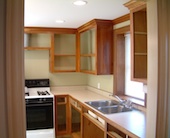
Shop Kitchen

About twenty years ago, I got some rough cherry boards from Grandpa’s garage attic. He had cut down a cherry tree in his yard back in the 1930s, sawed it into boards, and put it up in the attic to dry. It sat in my barn for more than 10 years before I could figure out what to do with it.

A few years ago, I decided that it was time to renovate the Collins Tool Company shop kitchen—make a nice place where we could fix lunches, and also demonstrate our tools. I didn’t have enough of the cherry to build boxes, and I didn’t want to buy a bunch of expensive plywood, so I decided to use it for the kitchen project. Read the full article…

Building a Chinese Chippendale Balustrade

Once you figure out the math, the rest is just glue and sawdust.

“You want what?” You’re kidding!”

That’s what I thought when some very good clients asked me to build a railing for a second floor deck above a living space. I hesitated — I normally do interior finish work, not decks.

But when they said they were thinking of a Chinese Chippendale balustrade, they got my attention. In general terms I knew what Chinese Chippendale design was — I’d just never built anything with the geometric fretwork patterns that mark that style. It’s beautiful stuff. Read the full article…

Shop Class as Soulcraft

A book every craftsman should read

“What sort of personality does one need to have, as a twenty-first-century mechanic, to tolerate the layers of electronic bullshit that get piled on top of machines?”
–Matthew Crawford, Shop Class as Soulcraft: Penquin Press, 2009

I recently taught a class on Mastering the Miter Saw to a group of mixed-age students at the West Valley Occupational Center, near my home in Los Angeles. I’ve volunteered to teach classes there before. The instructors teach drafting, framing, electrical, drywall—a general hands-on course covering everything about construction with blackboard backup. It’s a great program for anyone new to the trades. But I was surprised to find the class stalled by a lack of building materials. One instructor was digging into his own pocket to keep his class going. Read the full article…