Subscribe to TIC

Posts tagged with “craftsmanship”

Get Your House Right

It’s easy to distinguish between a two-hundred-year-old colonial house and a modern imitation—and not just because McMansions are puffed-up and super-sized. There’s a mysterious quality in a well-designed home—grace, proportion, something almost ineffable about the way they look “right.” Many older homes share that mysterious quality; few modern ones do. Read the full article…
Trestle Tables, Videos, and the Moisture Monster

I spent the first 15 years of my working life as a cameraman for—and then producer of—television commercials. In that career, your “film reel” was more important than your resume. It was a collection of a dozen or so of your best TV spots. By the same logic, when I finally switched over to woodworking, and started my own cabinet shop, I found that I would land more jobs when I could show a potential client photographs of our work. Over time, I carried an increasingly larger photo album in my attaché. Read the full article…

Building Custom Gates

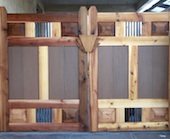
Between 1980 and 1994 I moved ten times—one fixer after the other, and a few rentals, too (fixers aren’t always profitable, even for a carpenter). When I moved into my current home, I promised myself I’d stay a while, and one of the first projects I wanted to tackle was replacing the gates. I accomplished the first goal, but it took a while before I got to the gates. Read the full article…

Making a Decorative Sunburst

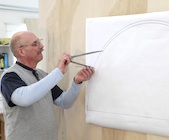
I was working on a remodel—a high-end home near the Hamptons—when the homeowner came out the front door with a magazine in her hand. “Look!” she said. “This is exactly what I want on top of my front door!” She tilted the picture toward me: a handsome Greek Revival portico decorated with an elliptical sunburst. “It’s going to cost you,” I told her. “How much?” she asked. “About $1,200,” I said. She smiled and said, “Do it.” Read the full article…

Carving a Volute

Where carpentry and sculpture merge; and CNC machines fear to tread

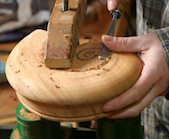
When you walk into a custom home, an old Victorian or an old Colonial, one of the first and most impressive sights is the stair. There it is in the great room. Graceful. Elegant. It is often the biggest piece of furniture in a home and one of the most valuable ornamental assets.

Or is it? Read the full article…

The Sliding Dovetail Cleat

Hang a mantel shelf without visible fasteners

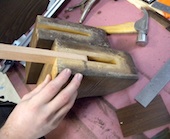
A recent article in THISisCarpentry—“Craftsman Style Mantel and Bookcases,” by Brian Cinski Jr.—referenced the book “Building Fireplace Mantels,” by Mario Rodriguez. Brian used this book to replicate a stunning Charles Rennie Mackintosh mantel and bookcase. I was intrigued, and ordered a copy of the book. Inside, I found many great tips, as well as a plethora of techniques I had never imagined. One in particular amazed me: the “sliding dovetail cleat.” Read the full article…

The Thorsen House

(with Gary Katz)

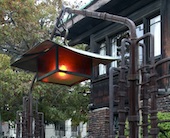
Not long ago, Gary Katz and I visited the William Thorsen House in Berkeley, CA. Built in 1909—one year after the Gamble House—the Thorsen House represents the “last of the large and elaborate wooden houses designed by Greene and Greene,” (Edward Bosley), for which Randall Makinson, in his book Greene & Greene: Architecture as a Fine Art, coined the term, “Ultimate Bungalows.” Read the full article…

Copper Rooflet

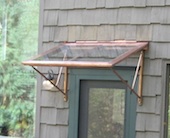
A copper rooflet isn’t made of wood, so what’s it doing in THISisCarpentry? Well, working with copper requires a lot of the skills that we use every day working with wood. In this project, the rooflet is meant to “look” like wood, and it serves a purpose that is generally filled by wood. Sure, I use some skills that are not technically considered “carpentry,” but if you’ve ever sweated a pipe-fitting, or made a pan-flashing for a window or door, or flashed a cricket, valley, or chimney, you’ve got the skills. So, brush off that dusty skill set, use your imagination, and apply it to a project that just might be screaming COPPER! Read the full article…

Wooden Storm Door

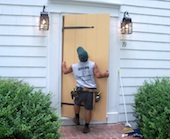
Like many carpenters, I’m always looking for an interesting challenge. I like tackling something I’ve never done before—and succeeding. Not only is it satisfying to push yourself, but a satisfied customer means good word-of-mouth, which (hopefully) leads to more work. Win-win. This is exactly what happened when one of my best clients approached me with an interesting project. Read the full article…

Ramps for the Handicapped

Volunteer work: good for the community and good for the soul

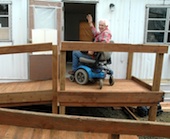
One of my first memories, in the early 1930s, when I was 4 or 5 years old, was of our mother taking care of a neighbor woman, Eula Hughbanks, who had tuberculosis. TB was more common in those days, with little hope for a cure, especially for poor people. The nearest medical care of any kind was 30 miles away. Such care might as well have been on the other side of the world for most of us, as few had an automobile. So people did what people have always done, especially in hard times—they took care of one another. Read the full article…

The Misused & Confused Chair Rail

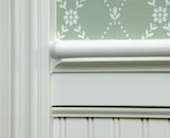
How high should we install chair rail? Ask most carpenters and they’ll either say 36 in., 32 in. or they’ll measure the back of a chair and tell you to lay it out so the chair won’t scar the wall. Well, I’m sorry to say, that unless your ceilings are 16-ft. tall, 36 in. is way too high for the chair rail; and letting the back of the chair set the chair rail height is like letting the size of a rug decide the size of a room. In most cases, it just doesn’t work! Read the full article…