



Another lesson in durable exterior trim
A few years ago, I wrote an article on Caulk-Free Column Wrap—a column that can be installed without having to come back in six months and caulk the corners or the trim. In this article I’ll take a second step in the same direction, and add some serious and much-needed improvements.
———
I pinch myself a lot. I’m always amazed at how lucky I am.
Fifteen years ago, I used to run to a pay phone when I got a page with a “911.” Now I send email from my iPhone—with spreadsheets and PDF files attached.
Ten years ago, I used slide film in my cameras. What a bear. And I carried a lot of gear: lights, stands, cords, scrims, flags. Sometimes sandbags! Now I use digital cards in my video camera, and can almost shoot film in the dark. What a great time to be a photographer—to learn the hard way; and be able to work the easy way.
What a great time to be a carpenter, too.
Sure, the economy hasn’t been this bad since the 1930s (and back then, they said the country would never recover!), but there’s still a lot to be thankful for. Here’s just one example:
About ten years ago, after seeing my work get torn apart by wood movement and early decay, I started using engineered wood and PVC trim. Now, like a lot of quick-thinking craftsmen, I’m using both materials together. I’m glad I learned the hard way; but I’m happier working the easy way.
Historic Design with Contemporary Tools & Materials
In my other article on caulk-free column wrap, rather than wrapping the rough post first, then installing the plinth or base detail on top of the column wrap (where wood movement tears up all the joinery!), I described a method for building columns from the plinth up. Let’s start right there.
The Plinth
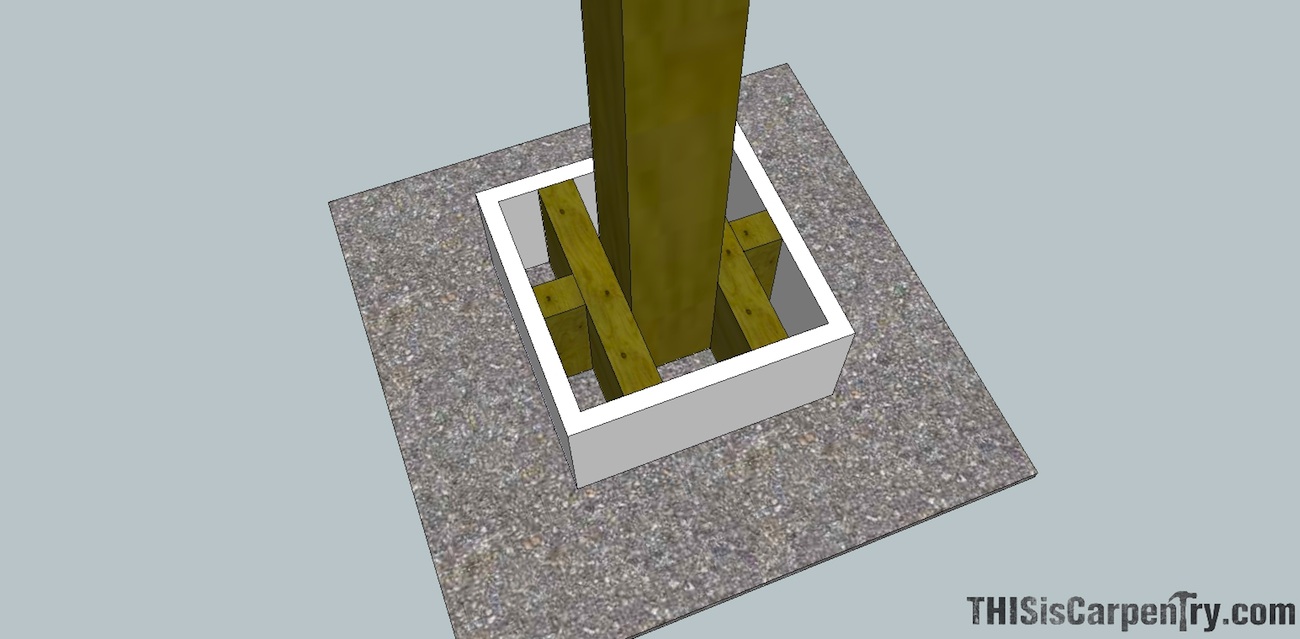
(Note: Click any image to enlarge. Hit "back" button to return to article.)
So that the plinth will be proud of the column wrap, back out the bottom of the column, then install the plinth section. Because the plinth always rests on grade—on concrete, stone, brick, or a deck—use PVC trim for the plinth.
The Base Cap
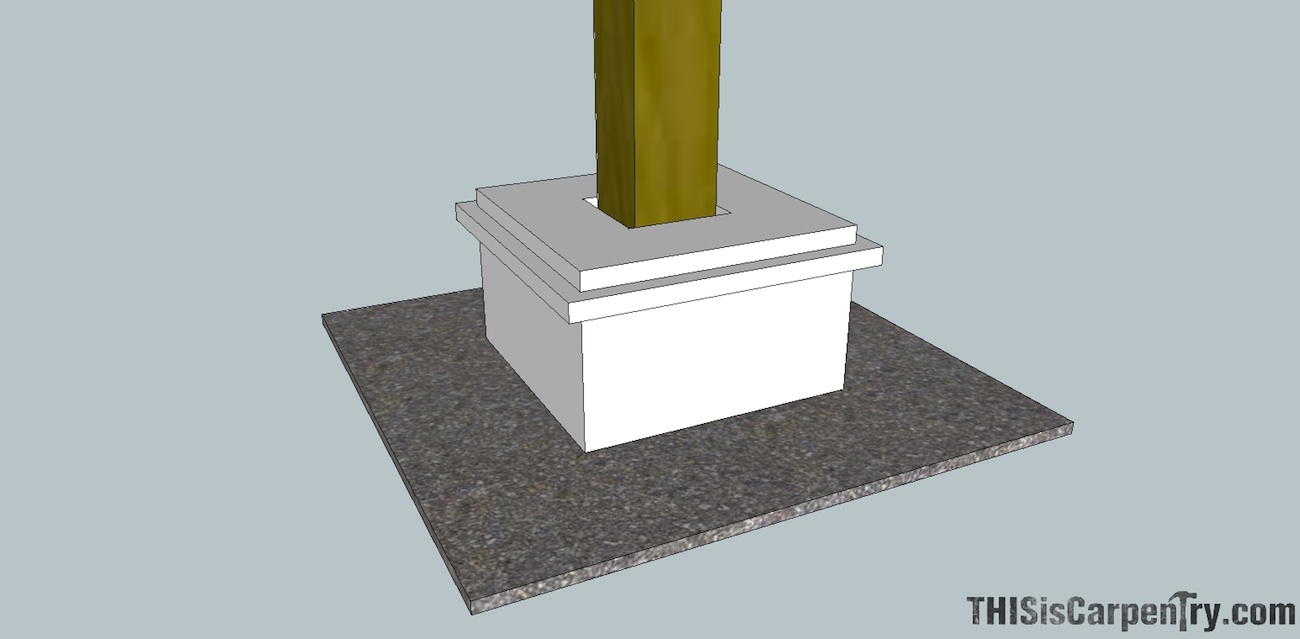
Baseboard mimics the plinth on a classical column, that’s why base cap molding usually has a torus shape. But craftsman-style homes rarely incorporate that profile; square edges are more common. This is a detail that you can not do with wood because there is no pitch for drainage on this square base cap. Use PVC trim because it won’t be damaged by sprinklers, standing water, or even a pile of snow.
The Column Wrap
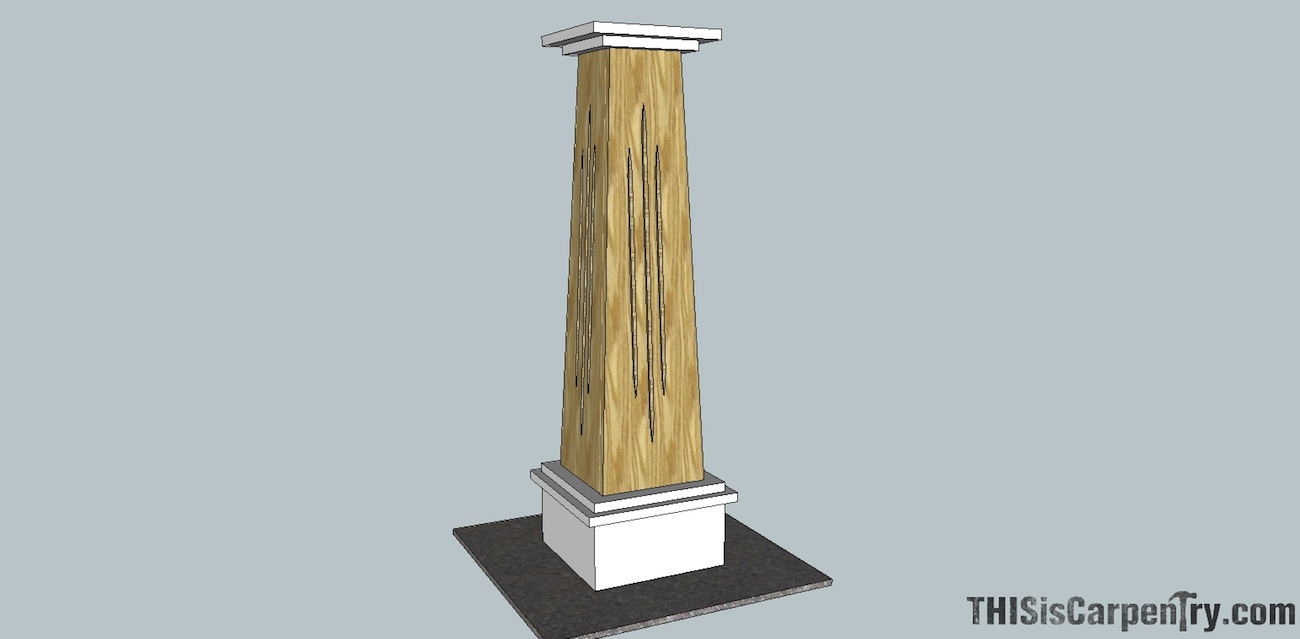
I wanted to demonstrate how to mix materials, so I used wood for the wrap on this column—though PVC could have been used, too. For a stain-grade newel, I might still opt for a paint-grade plinth—especially in this style, with so many flat surfaces that collect standing water.
The Cap
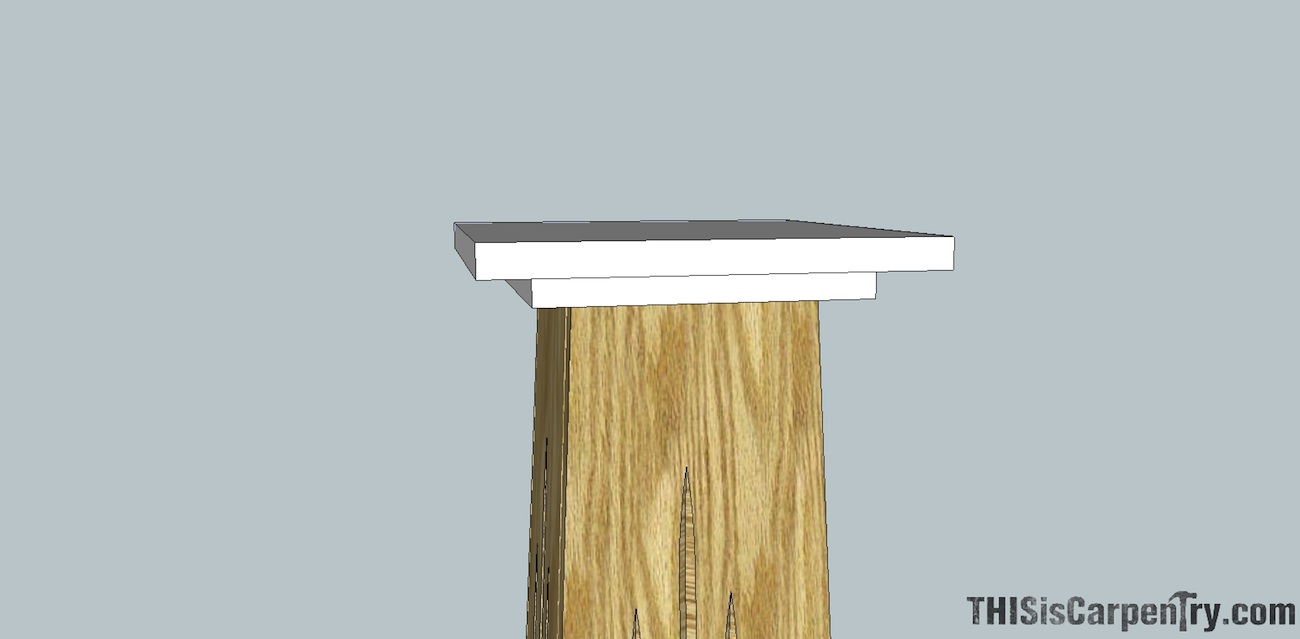
The cap must be made from PVC, too, because it is dead flat. Had I used wood, the cap would need to be pitched like a hip in all four directions.
Cutting the Flutes & Tapers
Assembly
I used a Domino to reinforce the butt joints on the column wrap. First, I eased all the edges with a 1/16-in. radius bit so the joints would be emphasized—in other words, so you’d see them immediately, which is a common feature on Greene & Greene Homes. Emphasized joints are also neat because any cracks in the paint at the butt joint are completely hidden.
| To ensure that the corners would be flush, I registered the Domino on the finished face of the narrow sides. | 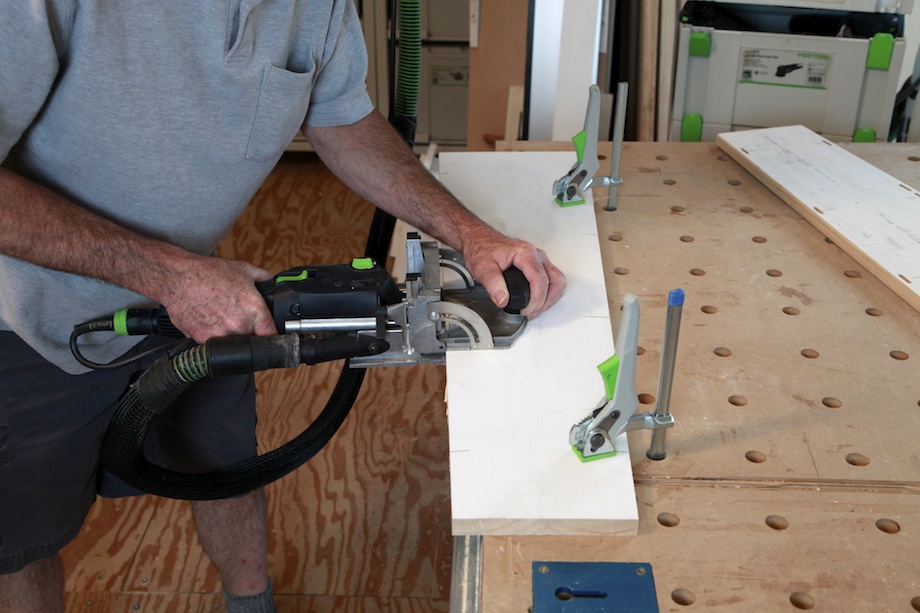 |
| Then I clamped a stop to my table and clamped the wide sides tight against the stop. Registering the Domino off the stop was the same as registering off the face of the narrow sides. | 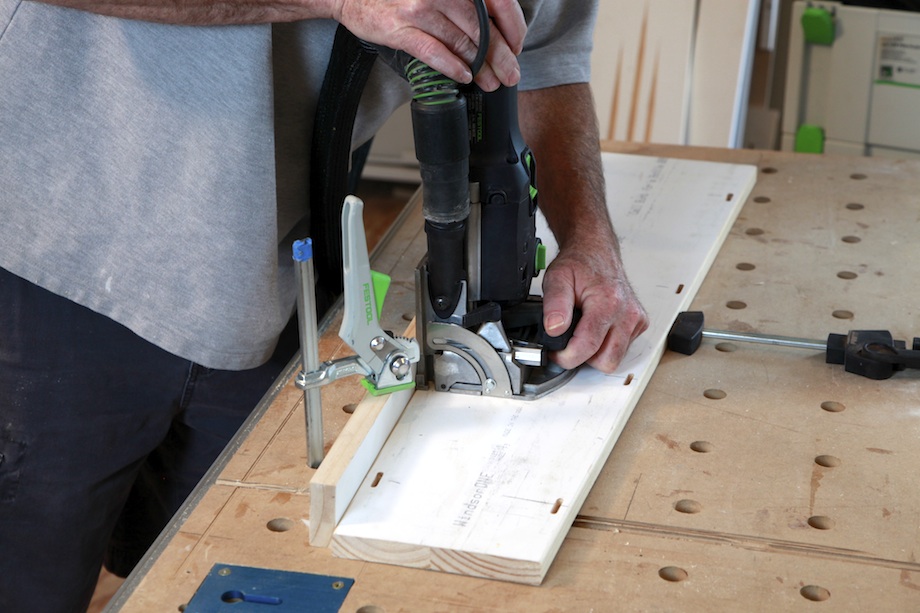 |
| I used the Dominos to align the emphasized corners, not the top and bottom, so I cut wider mortises for each domino, which made it a lot easier to assemble the sides for glue-up. | 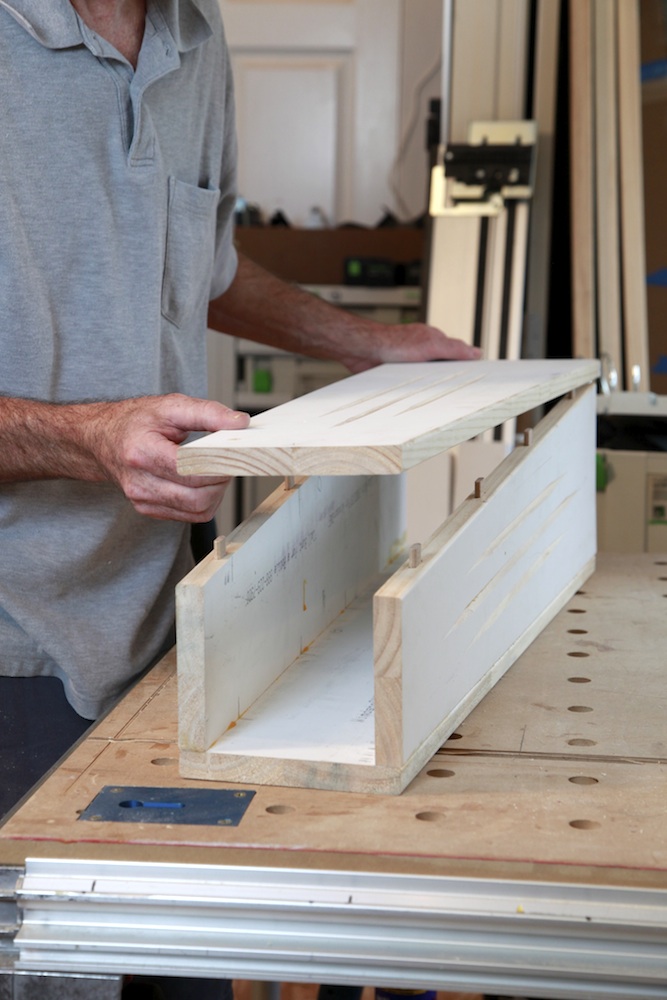 |
Expansion & Contraction
Wood and PVC move at different rates. Wood moves because of moisture content; PVC moves because of temperature. So the joint between the column wrap and the plinth and top cap must allow for expansion and contraction. But even if the whole column was made from wood, I’d want to include a caulk joint at the top and bottom, because the wood grain would be running in different directions—and that means different rates of movement.
Using backer rod is the only way to create a durable caulk joint, one that allows for expansion and contraction between dissimilar or similar materials. Here’s why:
If you don’t use backer rod, the center of the caulk joint is always too thick and deep, which means it won’t be flexible (see below)—it’s like a rock of caulking. And the edges, where you want the caulking to adhere, will be thinner than the center, weakening the adhesive bond right where you want it to be strong. That’s why caulking always cracks along the edges, sometimes splintering the wood fibers as the wood moves.
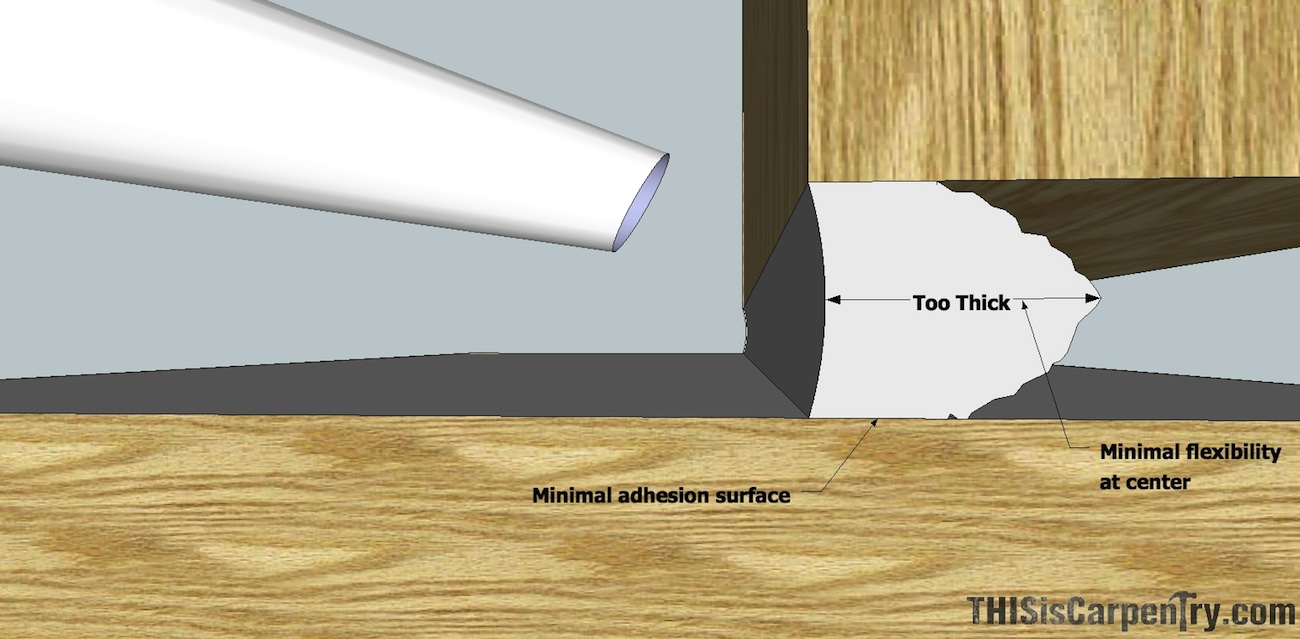
Not only is backer rod cheap, but it saves on caulking! Plus it ensures that the center of the caulk joint will be thin and flexible, and the outer edges will be much wider than the center. That’s the right recipe for maximum flexibility and maximum adhesion.
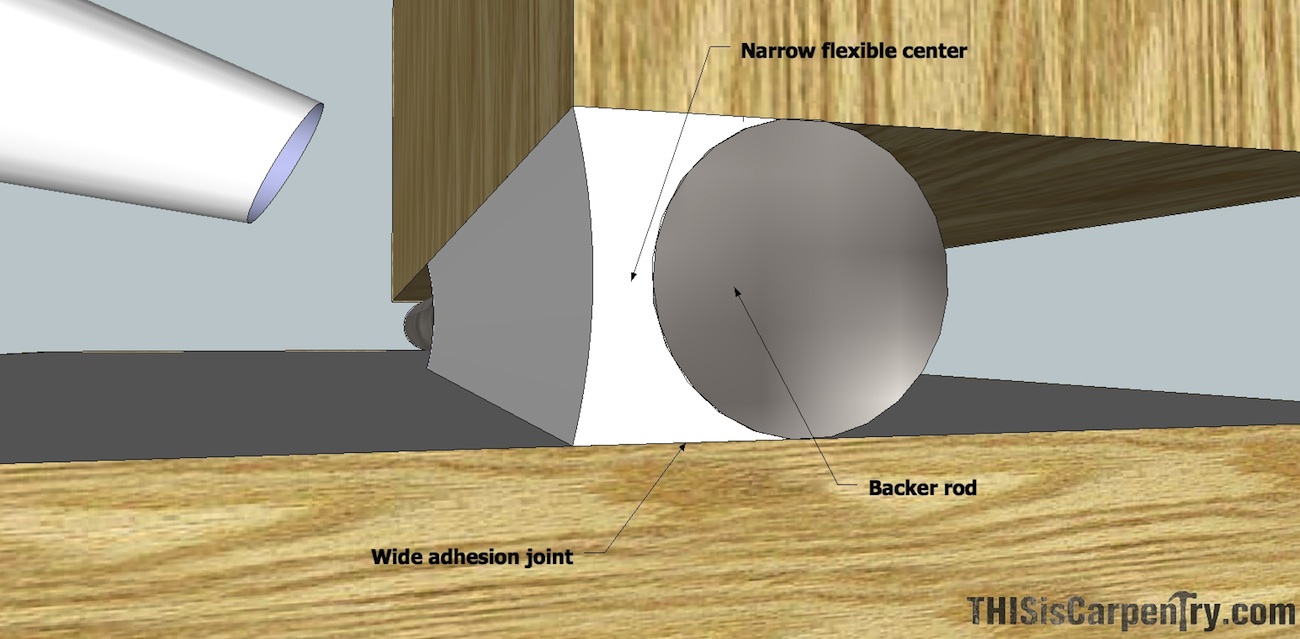
| Before installing the column wrap, I pin small 1/4-in. standoffs on top of the base cap—small chips of 1/4-in. plywood worked for me. Those spacers allow just enough room for 3/8 in. backer rod. | 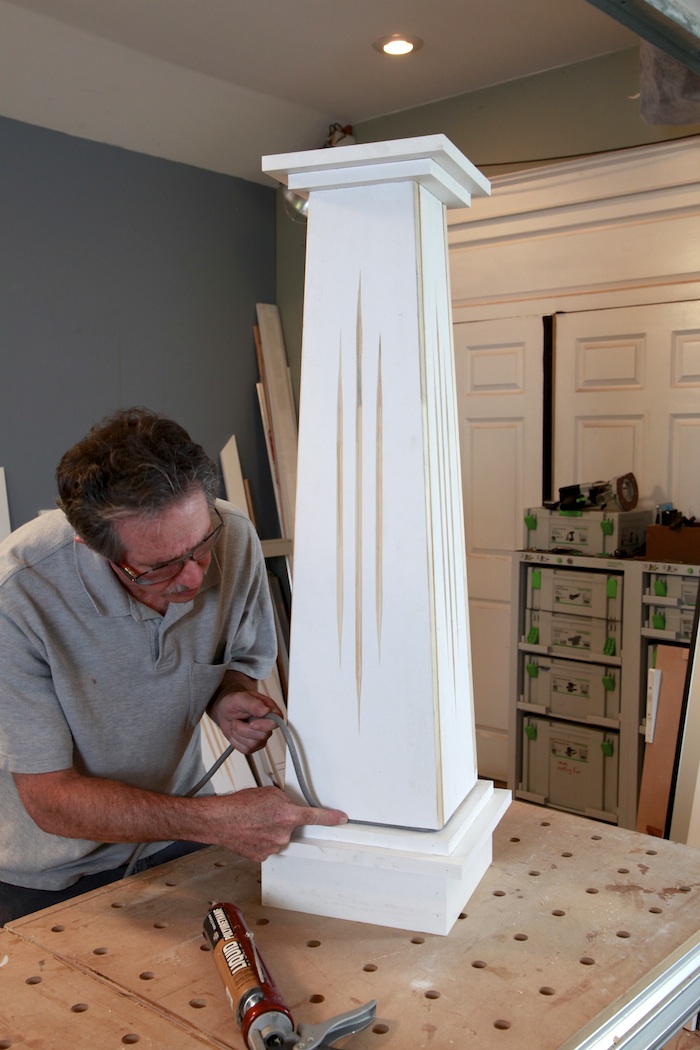 |
Gary,
Aw shucks, I’ve never heard language like that on any of my jobs when there’s a screw-up, not even when I was working with a minister. I really enjoy the articles and especially the videos. It’s like a ROADSHOW without the swag from windsor one.
Kevin
Dog gone it!
Hey Gary, As always, great article and excellent video.You make it very easy to understand with great detail writing and excellent step by step videos. I’ll be making a template guide for my router along with some sleds for my upcoming projects I have. Also Carter and I enjoyed your new Doorhanger’s dvd and thanks for the pencils. Carter’s using them in school. .
Thanks You
Manny
Gary
Nice detailing as always. I have been looking more & more at bungalows: their size, layout, & especially…their detailing. A few of those columns out front with PVC & maybe CVG fir for the wrap (as I’m from the Pacific NW) would look fantastic.
Question on ’emphasized joinery’. I understand the need for it but customers want things tight like a drum. Are there times & places, especially in exterior work, where you can assemble a similar joint without mother nature beating it to all get out?
Thanx
You can make the same joint with CVG, without easing the edges, and it looks okay, but I’d probably want to miter the corner and reinforce the miter with dominoes, and make sure the material is about 12-14% MC before working with it, and keep it at that MC until it’s installed.
Great looking newel Gary! Thanks for sharing
Gray,
Great video and neat router jig.Thanks for sharing.
On our last job the plans called out for redwood boxed newel post. My first thought was to replace the redwood with Windsorone Protected, because the clear redwood we get to day is too soft. The Windsorone Protected we get has a smooth side and the other side is rough saw-en which makes it hard to assemble as a boxed newel. What are you using for the boxed newel? Would the Windsorone work in the attached picture? Should I haved used the backer rod on the PVC hopper cut newel post shoes?
[img]http://www.thisiscarpentry.com/wp-content/uploads/2010/10/redwod-post.jpg[/img]
[img]http://www.thisiscarpentry.com/wp-content/uploads/2010/10/PVC-Shoe.jpg[/img]
I used WindsorONE’s Protected trim boards. I have a bunch I brought home that are S4S. I know they don’t stock the S4S on the West coats in Protected boards. I’m not sure about the glue-up with the re-sawn surface…if it would really get in the way of a tight joint, especially if you ease the edges and draw a little attention to the joint. Then you don’t have to worry about the re-sawn surface. But the PVC plinth is the ONLY way to go. You’re not supposed to install ANY wood product against concrete, brick, stone, etc. And really, even on a deck, the plinth and bottom of the column wrap shouldn’t touch the decking. But if it’s PVC…no problem. And the backer rod is the best insurance against both irregular movement between cross grain wood or between wood and pvc, plus it helps create a much more durable and water-tight caulk joint.
Howdy everyone –
WindsorONE+ Protected S4SSE (Smooth 4 Sides, Square Edge) is available in selected locations on the West Coast. Sim, I think you are in the Bay Area – Economy Lumber in Campbell, CA stocks it.
Don’t hesitate to contact us directly via email or cell if you need help finding certain patterns in your local area.
Great article Gary!
Best,
Carl Christoferson
Director of Sales, Western US
Windsor Mill/WindsorONE
carl@WindsorONE.com
888-229-7900
Hey Gary, very nice articale. I love the sled you made for the flutes! I also love the fact you used wood. I ‘ve used Azek enough to know I don’t like working with the stuff at all. Man, what a mess it makes…sticks to everything. Considering all of the new latex paint that is out now, like SW Duration ,do we need to use Azek unless it is in direct contact with masonary or is going to get wet alot?
As always Gary, the solutions you come up with are simple and well thought out.
I wondering if the same concept of the backrod can be applied to crown trim?
Be well.
Noel
NY
You mean crown applied to a column?
What kind of tools are you using. Festool throughout? Stop clamps?
John,
Are you talking about cutting the taper or the climbing flutes? I used the TS55 to cut the taper, and a guide rail on my MFT—running lengthwise across the table because the pieces are too long to cut the other way. I use a little cobbled together fence to help secure the pieces at the right angle, so you can cut more quickly, and so you can get two sides from each piece of stock. I didn’t use any stop clamps. The router is a Festool 1400 attached to a home-made sled.
How do you keep the guide rail from slipping?
The guide rail is mounted to the mft table, just like one normally would be. I used a longer rail, so I could mount it across the length of the table. I picked up an extra set of mounts and stops which I installed on the guide rail and mft table for cutting in that position. It’s pretty handy.
Gary
Can you provide info on the climbing flute jig componets?
Thanks Gary
Chuck,
What do you mean by ‘components’? The only ones I can think of are the knobs and t-bolts that I mortised into the bottom of the sled guides. Oh, and the template guide mount from Festool.
Gary
Can anyone point me toward any articles or offer guidance on proper proportions for this style of post for a craftsman porch, as far as the taper of the column and ratio of the base (plinth) and cap is concerned. I have always just winged it before ( as many of us do) but am starting to realize what a large role proper design and proportions plays in the over all feel of the finished product. By the way overall height of tapered column will be approximately 4′ with a capped Brick pier below. Thanks for y’alls help.
Gary-
In terms of durable exterior trim, have you got any ideas for wood posts for a picket fence that won’t rot out in ten years? I’m in a historic district so I can’t use plastic or even PT. I was thinking of sinking 2″ galvie pipe into the concrete post holes instead of solid wood posts, then wrapping them with Windsor One to allow for air movement, then maybe sneaking a PVC skirt and cap over the tops….but have never seen this done. Any thoughts?
thanks, Gary.
Michael,
I can not believe that you can’t use PT. No other wood product is approved for ground contact. I’m sure your historic district allows PT for posts. Trust me. I’m positive they do.
As for the pickets: WindsorONE is protected with a PTI solution (non-metallic / organic), but that’s not good enough for ground contact. I know you won’t be using the WindsorONE for posts, but since the picket fence will be close to the ground (closer than 6″), I’d use cedar for the pickets. Try to find boards with as much vertical grain as possible. Of course, mahogany or white oak would be better…but I tend to use that stuff for furniture, not fences.